
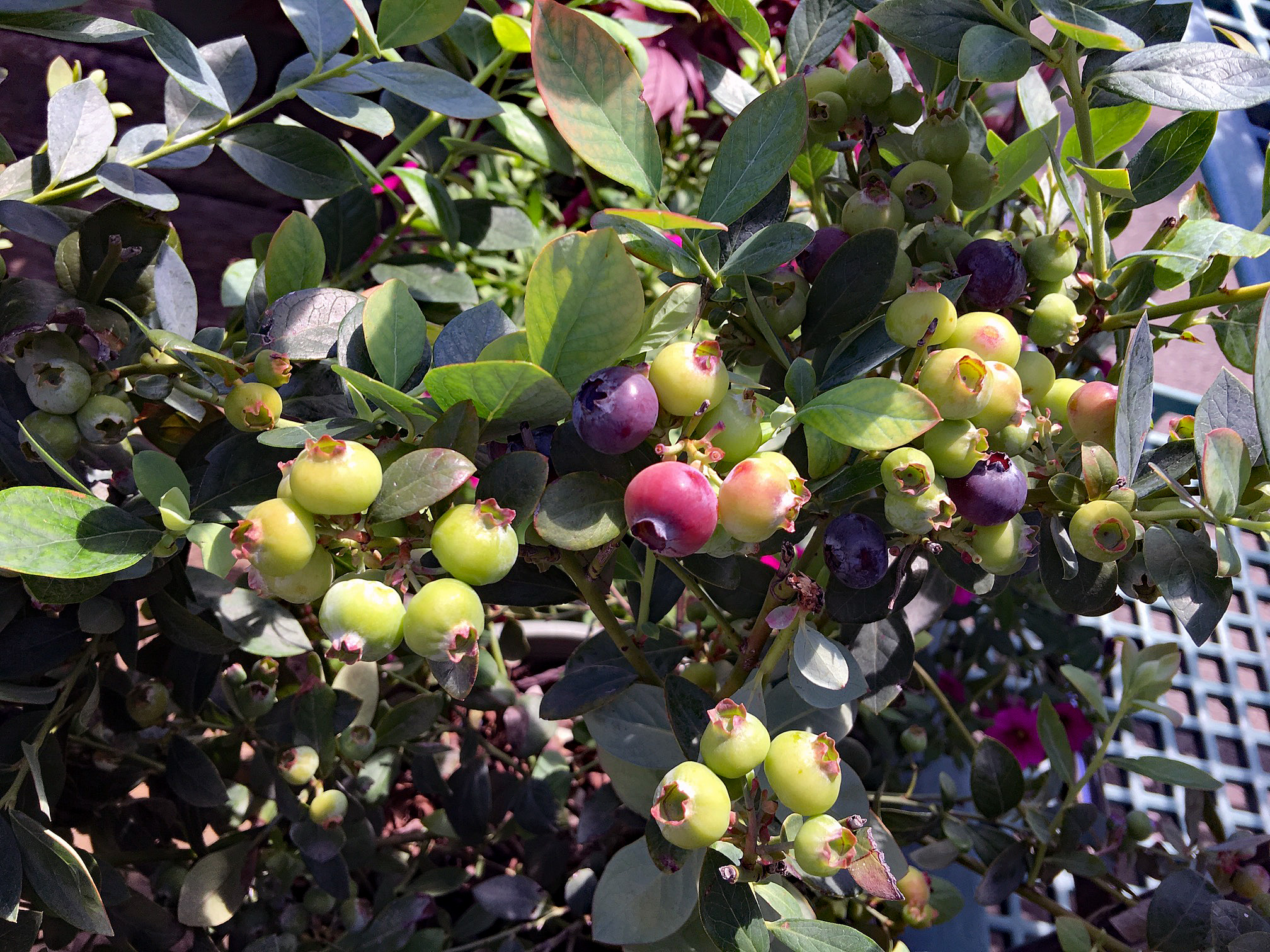
Question:
Three years ago, we were given several blueberry plants and planted them in containers. So far, they have yet to produce any berries. How long must we wait until the plants start producing, and when should they be pruned?Answer:
- Blueberry plants, when properly cared for, can bring a bountiful harvest of delicious berries at an early age. For this to happen, the plants must flower, and the flowers need to be pollinated.
- There are early-flowering varieties, mid-season, and late-blooming Blueberries, each with unique charm. Another variety from the same blooming period is the necessary pollinator.
- Blueberries are also grouped according to their winter chill requirements. Because of our mild winters, the Southern Highbush, a low-chill variety, is the best-suited blueberry for Bay Area gardens.
- Knowing the various names would answer many questions, but I assume they are unnamed. So, that leaves you with two options. You wait another year to see if the plants bloom simultaneously. If so, then the problem is that the varieties are not suited for our climate, or they are the same variety.
- You need two different varieties with a similar blooming period. If the varieties bloom at other times, you could replace one with another variety or increase the number of blueberry plants in containers.
- The second option would be to replace both varieties now and save a year. A good selection of Blueberries is now available at your favorite garden center. I might suggest Bountiful Blue or Sunshine Blue as they are self-fertile and you can avoid the pollination problem altogether. This would be my preferred option.
- Blueberries are pruned annually in February before the flush of new growth. Excessive pruning should be avoided because it dramatically reduces the crop for that year. The plant(s) is kept fairly open by cutting out weak and older non-producing stems down to the ground.
- You should also remove all the dead or dying branches. Generally, you keep four to six vigorous, older stems and one to two new solid shoots per bush. The new shoots will eventually replace the older stems. Another reason for pruning is that it limits the plant from overproducing.
- If all the flowers are left to develop into berries, the berries will be small, ripen later than normal, and the plants will have little new growth.
Question:
What can I apply to eliminate clover in my lawn?Answer:
- Ortho Weed-B-Gon and Bonide Weed Beater Ultra are selective herbicides that remove clover and other broadleaf weeds without harming the grass. You could also apply a 'Weed and Feed' type turf product as it should control the clover and many other broadleaf weeds.
- So, eliminating clover shouldn't be that difficult. Another option is to leave the clover. A mixed turf of grass and clover is not that undesirable. Clover doesn't require much care, and it's water-wise.