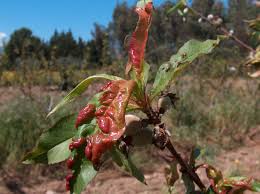
Is now the time to start to spray for Peach Leaf Curl. What is the best dormant spray to use?
Answer:
Peach Leaf Curl is a perennial problem on peaches and nectarines only. Curly leaf on plums, cherries, apples and pears is caused by Aphids and treated it later in the early spring. Now is the time to apply your first application of a Copper Dormant Spray starting around Thanksgiving or when fifty percent of the leaves have dropped instead of waiting until next year. The rest of the deciduous trees can wait until January; however, it wouldn’t hurt to spray them now too. The Copper fungicide is an organic spray used on ornamentals, edibles, and turf for fungus diseases. The late fall application of a Copper Spray gets the overwintering fungal spores before the tree’s bark covers them over as the temperatures drop. A second application is suggested in early February when the peach and nectarine buds are in the pink bud or popcorn stage. Peach Leaf Curl is a water activated fungus that washes into the open buds and infects the leaves. So, wet rainy conditions during flowering is a problem. The spores insert themselves among the leaf cells where they stimulate cell division. The emerging leaves are a reddish color, distorted, thickened, and blistered looking before turning yellow or brown and dropping off. A new set of leaves will develop but with a prolonged rainy season, like in 2012, the next set of new leaves may be affected as the fungus continues to be active until the rainy season concludes.
Question:
I relandscaped my front yard with water-wise plants but I kept an area for grass. It was reseeded with a dwarf Fescue called Bolero. It germinated without any problems but it is not a dark green color. Instead, it's two tone, dark green with light green scattered throughout it. What happened to cause this problem?
Answer:
No problem here, the grass is just immature. Bolero, like other Dwarf Fescues, is slow to establish itself, especially when sown in the fall. Seeded in the spring and/or summer the long and warm days hastens the growth so the two-tone color isn't as apparent. In the fall, the opposite is true. Bolero grass seed doesn't usually have a uniform color until after the fourth or fifth mowing. It normally takes eight to ten weeks; however, it can be longer depending on when it was seeded. So, the two tone color would be typical now, if you seeded in October. It will even out with time so be patient and don't lose any sleep over it.