
Question:
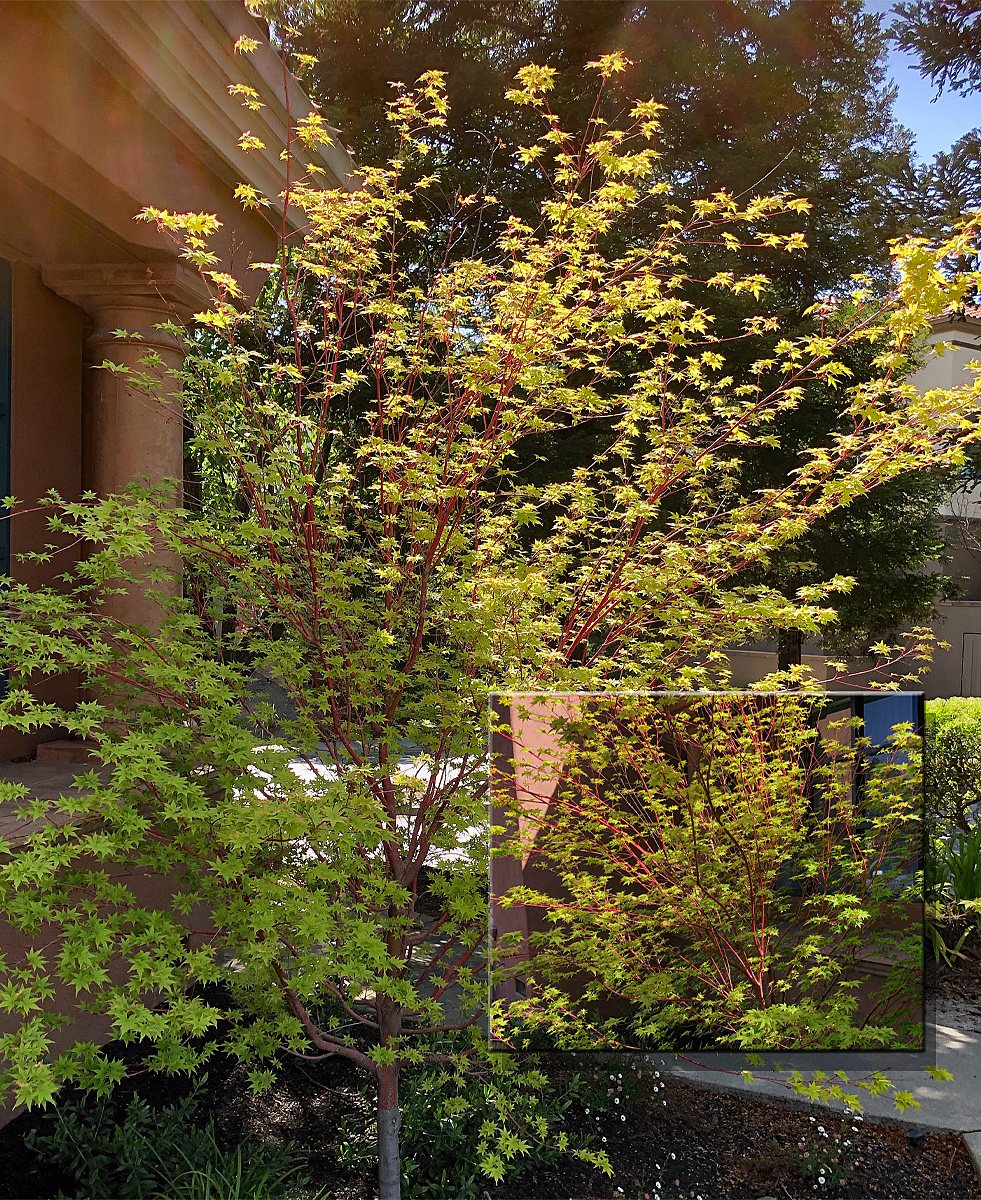
Two years ago, I planted a Coral Bark, Japanese Maple (Acer palmatum ‘Sango-kaku’), for the red bark and light green foliage. Now , some branches are much more prominent in diameter, and the foliage is a different color. If left untouched, will this growth eventually take over, or should I cut them off?Answer:
- Yes, I'd remove the rogue branches at the point of origin. They could, in time, be the dominant part of the plant if left unchecked.
- With Japanese Maples, the major pruning should be done during the dormant season after the leaves have fallen. This would be from late November to early February before the sap rises and new leaves emerge in the spring.
- The winter pruning includes removing all dead and dying branches, those that are rubbing and crossing, and thinning out the twiggy growth in the canopy.
- Japanese Maples can be shaped year-round except when the sap is rising, and all the plant's energy is devoted to the emergence and development of the new foliage.
- The pruning cuts should be made beyond a pair of buds on a twig or branch. Usually, this will produce two lateral shoots. When removing a large limb, just like pruning any other woody plant, the cut should be made just above the branch collar or ridge.
- The branch collar or ridge is where a branch joins an older branch or stem and is clearly seen. It would help if you never cut below this natural barrier as it creates an even bigger wound surface for a disease to attack.
- You get behind the plant's last line of defense when you miss beyond this point. At the same time, an unnecessarily long stub above the collar should not be left, as it provides a more significant food source for any disease to build up its strength before penetrating the tree's natural defense system.
- With the Coral Bark Japanese Maple, you should periodically remove the inside growth as it enhances the graceful trunk and branching structure during winter when the foliage is absent.
- I can't tell you how sad it is to see all types of Japanese Maples when pruned into a dense, compact, circular, or some other form. Their natural, graceful shape is destroyed.
- Pruning Japanese Maples and other plants is a trying experience for many gardeners. There is an intense fear that they will do something wrong and the plant will die. Plants rarely die from pruning. They can look unattractive, but they don't die.
- One final thought, .At the beginning of the pruning season, have your pruning shears, loppers, pole pruners, saws, and any other equipment sharpened. The need for sharp pruning tools cannot be overemphasized. A clean pruning wound heals much more quickly than jagged, torn wounds created by blunt tools, and the wounds calluses over more effectively.