
Question:
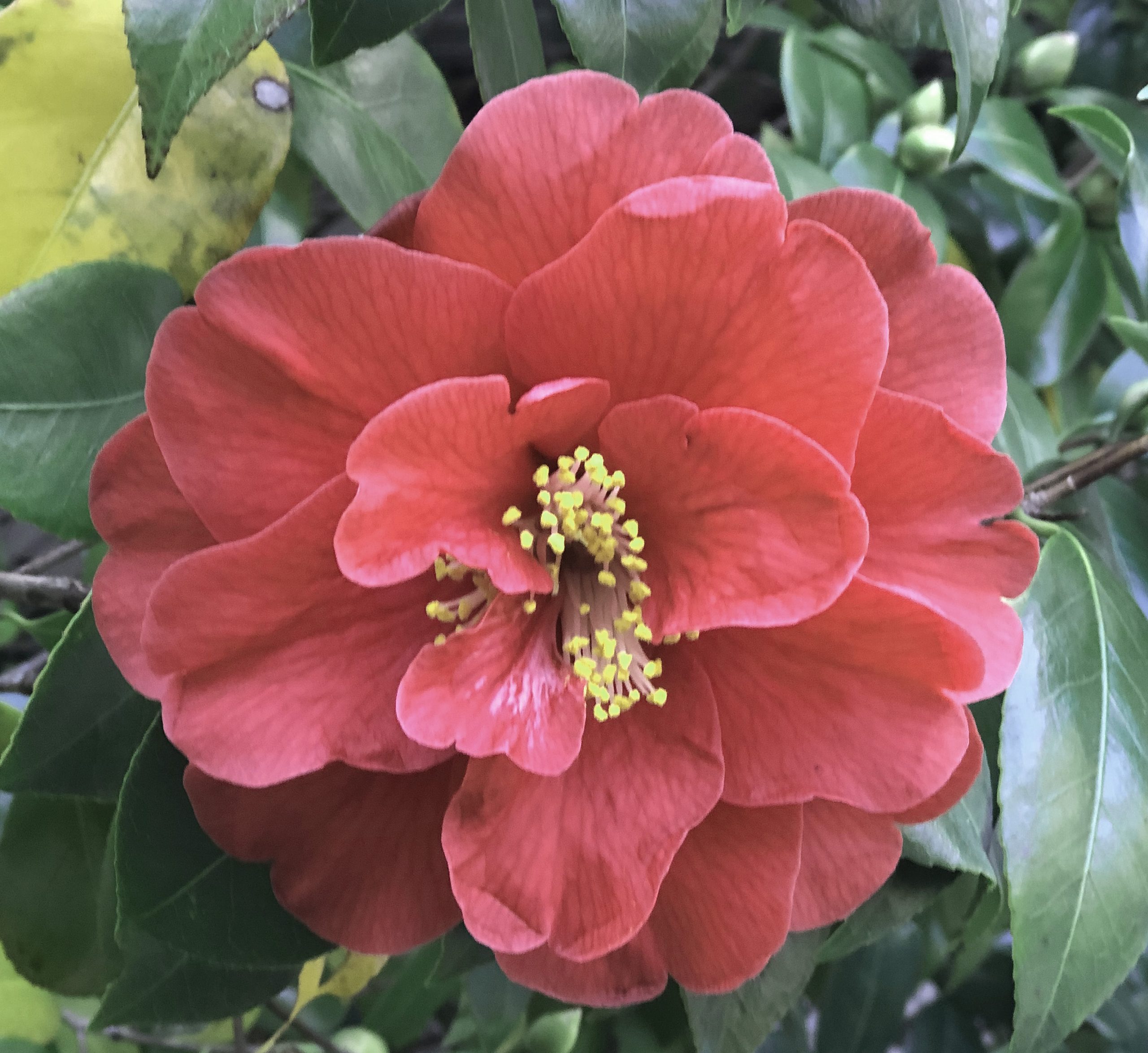
We removed several trees for wildfire concerns. They were a beautiful shade for two mature Camellias. I now have to move because they will receive too much sun. When is the best time of the year to transplant them?Answer:
- Camellias are best transplanted when they are in bud and bloom and not actively growing. This is when evergreen plants are in a resting period or dormant.
- So, now is a perfect time to relocate them. However, the winter rainy season makes the task challenging. So, the transplanting window is open until the end of April.
- They also can be moved after noon temperatures are below eighty degrees. Last year's cool spring meant the transplanting window was open until mid-June.
- When transplanting Camellias, the mortality rate increases dramatically if they are bare-rooted. So, be careful in digging them out of the ground. Camellias are shallow-rooted, so most roots will be close to the soil surface.
- You start digging about a foot or more from the edge of the drip line. The shape of the root ball should be more like a trapezoid than a cube to accommodate the typical surface roots.
- The new planting hole should also be a trapezoid shape. The backfill is amended with an Acid or Azalea, Camellia, and Rhododendron Planting Mix. It's a fifty-fifty mixture with the native soil or a hundred percent of the planting mix.
- It would help to place the root ball a half-inch above the soil grade to allow for settling. In about a month after transplanting, you begin your feeding schedule.
- After all this, your Camellias shouldn't miss a beat in their new home.
Question:
My two cherry trees were traumatized last spring and summer as they were heavily hit with Black Cherry Aphids. I kept cutting off the affected leaves, but the trees looked terrible all summer. In the past, I maintained control of the Aphids by putting a ring of the sticky stuff around the trunk. This year, it didn't help at all. What can I do for an Aphid-free season this year?Answer:
- Aphids are a problem on Cherry, Apple, and Plum trees. It causes the leaves to curl up like one of those Italian cookies.
- Many gardeners confuse it with the curly or Peach Leaf Curl found only on peaches and nectarines. Hopefully, you had an opportunity to apply a dormant spray of Copper or Horticultural Oil. This cleans up any over-wintering insects on the bark and in the crevices of the trees, but it doesn't prevent the Aphids from returning.
- You control the Aphids by diligently checking the trees as the leaves are emerging for curly leaves. Once you see the problem, pick the curly leaves off the trees and spray with Insecticidal Soap, making three applications a week apart.
- I'd still apply the sticky stuff, Tanglefoot or Pest Barrier. Ants ferry aphids around as they feed on the clear sticky residue, ' Honey Dew.'
- Aphids are present year-round but are only problematical in the spring.