
Question:
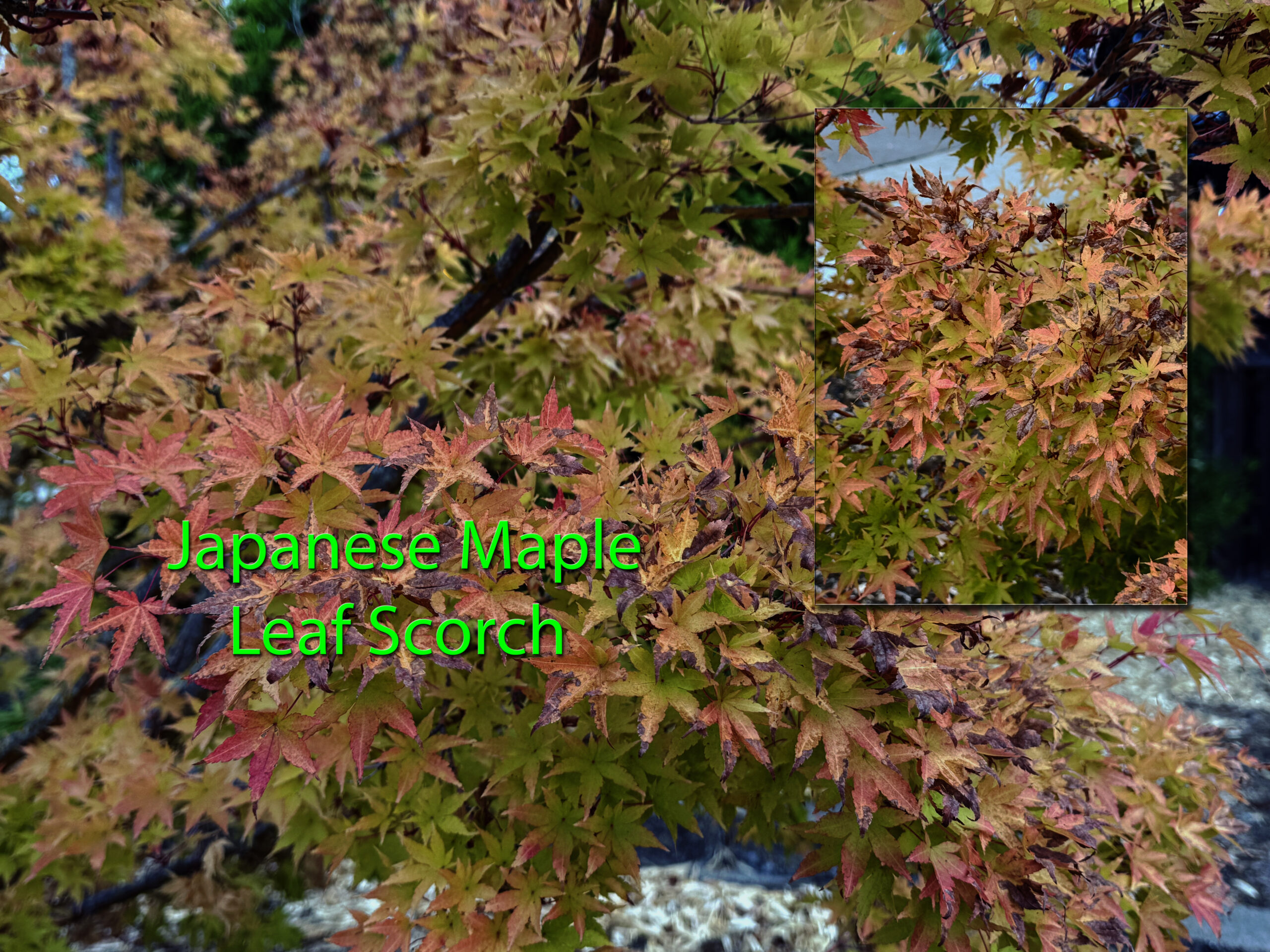
I planted a Japanese Maple two years ago on the west side of my home. For the last two years, it has suffered from leaf scorch and looks terrible. Should I relocate the tree, or might it resolve with more water and time?Answer:
- Leaf Scorch is the number one complaint Japanese Maple owners have. It causes brown, crispy leaf edges, especially mid-to-late summer, and it’s almost never a disease.
- Closer to the coast, summer marine salt spray can also cause leaf scorch.
- Leaf Scorch happens when the tree loses water through its leaves faster than roots can replace it. Hot afternoon temperatures, dry winds, inconsistent watering, and shallow roots in compacted soil are the primary causes.
- The condition usually begins at the top and along the plant’s edges. In plants, this is the farthest distance water has to travel. The rest of the foliage remains green or red.
- Before moving it, I try correcting the issues where it’s planted.
- Next April, feed your Maple with Happy Frog Japanese Maples fertilizer to encourage new growth.
- In mid-May, apply a 2- to 3-inch layer of organic matter beneath the canopy, spreading it evenly and keeping it away from the trunk. This layer helps insulate the roots during very warm mornings and late afternoons
- . I would also water the Japanese Maples twice a week across the full canopy so the entire root system receives adequate moisture.
- Next, apply Bonide Wilt Stop to protect the leaves; it is the same material used for cool-weather protection. Wilt Stop guards the leaves from excess water loss, and I’d apply a second application in August. Think of it as Clap Stick for plants.
Question:
My three-year-old Thornless Raspberries have yet to produce any berries, only stems and leaves. They receive afternoon sun, ample water, and a spring feeding. Each October, I prune them to roughly six inches above the ground to control the runners. What am I doing incorrectly?Answer:
- Hopefully, you have already pruned them, as that’s your problem.
- Raspberry plants produce fruit on second-year growth, known as canes. Once these canes yield fruit, they cease producing and are typically removed at ground level.
- You are partly right: clearing away last year’s canes. Yet you are mistaken about cutting the new shoots that emerge during the growing season, since they form next year’s berries.
- Your berry plants should not grow on a fence; instead, use a trellis or another support structure to keep aggressive underground stems from spreading into the neighboring property.
- After harvesting, remove the old fruiting canes and replace them with new canes from the base of the bushes, on the trellis.
- These canes develop during the growing season. I’m assuming the original plants originated from cuttings rather than seeds, since raspberries grown from seed tend to be unpredictable.
- One variation involves everbearing raspberries. Everbearing raspberries (Rubus idaeus) yield fruit in spring and again in fall. Unlike summer-bearing types, which may produce purple or black fruit, most everbearing varieties bear red berries.
- For now, you should take no action. You’ll harvest berries next year only if you haven't pruned; otherwise, the first harvest shifts to 2028.