
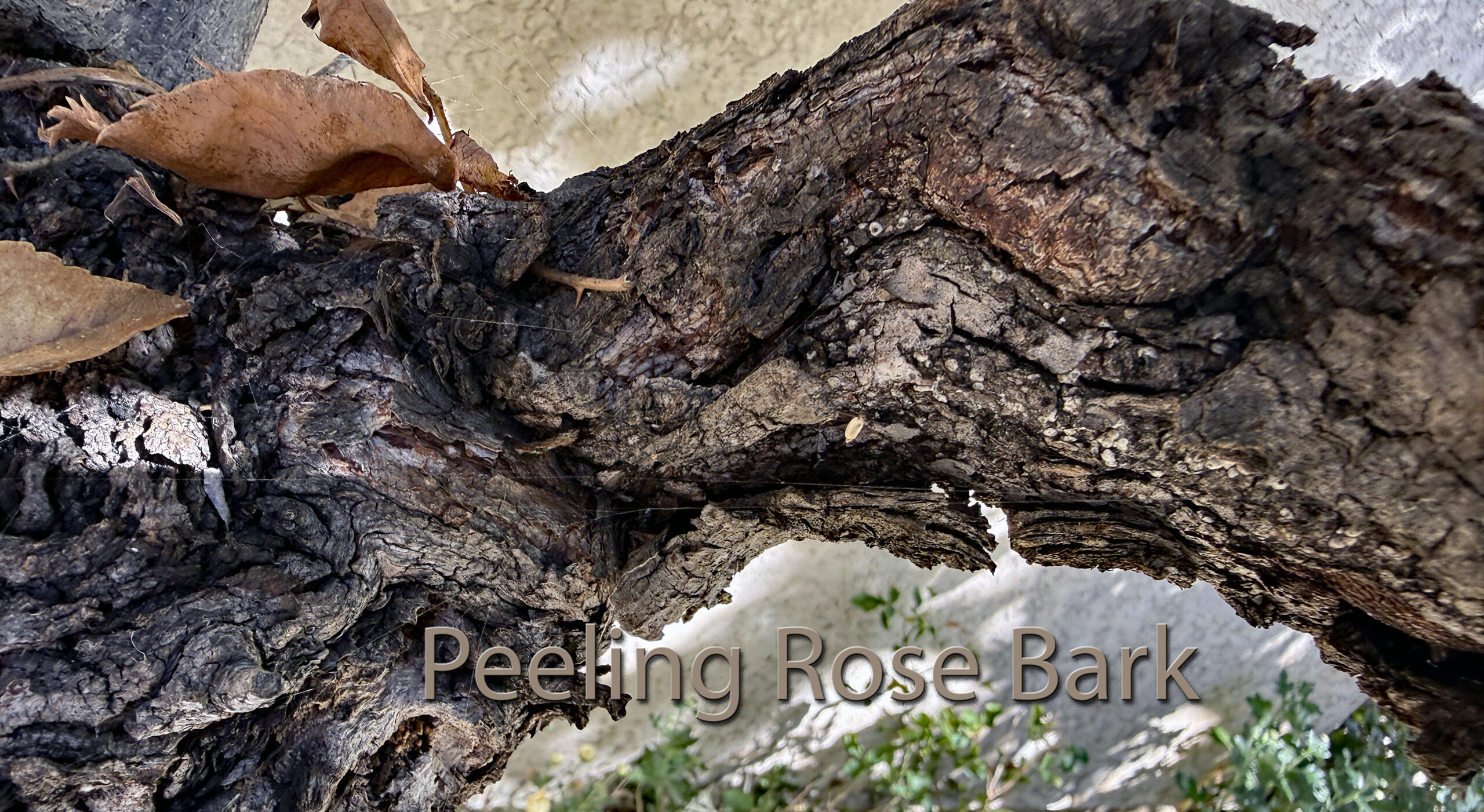
Question:
I have several old roses in planters. The bark on one has peeled for several years; when I touch it, the bark falls off. Another nearby rose seems to have the same issue. Is this condition contagious?Answer:
- Peeling bark on roses may or may not signal trouble.
- Bark on older roses naturally sheds below the bud union, where a rose is grafted onto rootstock. If the tissue there shows no clear discoloration, I would not worry excessively. However, inspect any area above the graft carefully.
- Bark acts like a plant’s skin, protecting internal tissue from injury, infection, and moisture loss. A rose has multiple bark layers, much like our epidermis. Losing the outer layer isn't alarming, but if peeling reaches the cambium, vigor may decline severely, or the plant may die.
- Several factors influence bark.
- Sunburn or scald harms green canes, turning them black and causing older bark to peel. Foliage normally shades the bark and prevents this damage. Pruning or deadheading in warm weather can expose canes unintentionally.
- Tree rose trunks facing the southwest sun often peel. In hot climates, people paint the trunks white to reflect heat.
- Younger blackened canes usually die, while older ones may attract borers. Borers do not attack healthy tissue. You can find them by scraping the bark with a knife, as they lie just beneath the surface.
- Borers are white or amber, usually linear, and visible to the naked eye. The simplest remedy is pruning off the affected canes.
- A fungus marked by reddish-brown patches and purplish-black lesions may affect green bark and cause peeling, though this is rare. Removing the affected area offers a simple solution.
- Sunburn or scald harms green canes, turning them black and causing older bark to peel. Foliage normally shades the bark and prevents this damage. Pruning or deadheading in warm weather can expose canes unintentionally.
- The problem may be varietal, which is typical for Lady Banks Rose, a yellow or white climbing rose. The outer bark sheds in long strips, creating a weathered appearance during winter.
- With in-ground planting, a string trimmer or lawn mower might damage the base of the bushes.
- In short, peeling bark on your roses is generally not a major issue.
Question:
What season offers the best conditions for planting Rhubarb? Does it thrive more in sunlight or shade?Answer:
- Plant rhubarb from January through May. Root divisions arrive early and offer the best choice, while container plants emerge later in the season; avoid seed-grown plants because they often disappoint.
- Three or four plants suit a typical family of four. Select a site with half a day of sunlight, preferably in the morning or early afternoon, and space the plants three feet apart. I would dig large holes and amend the backfill with organic matter.
- Additionally, place a handful of organic starter fertilizer at the bottom of each hole. During the first year, let the stalks develop without harvesting; a modest yield is acceptable in the second year.
- Divide the clumps every four years or when the stalks begin to thin, which occurs during winter. Note that only the stems are edible, because the leaves are poisonous.