
Question:
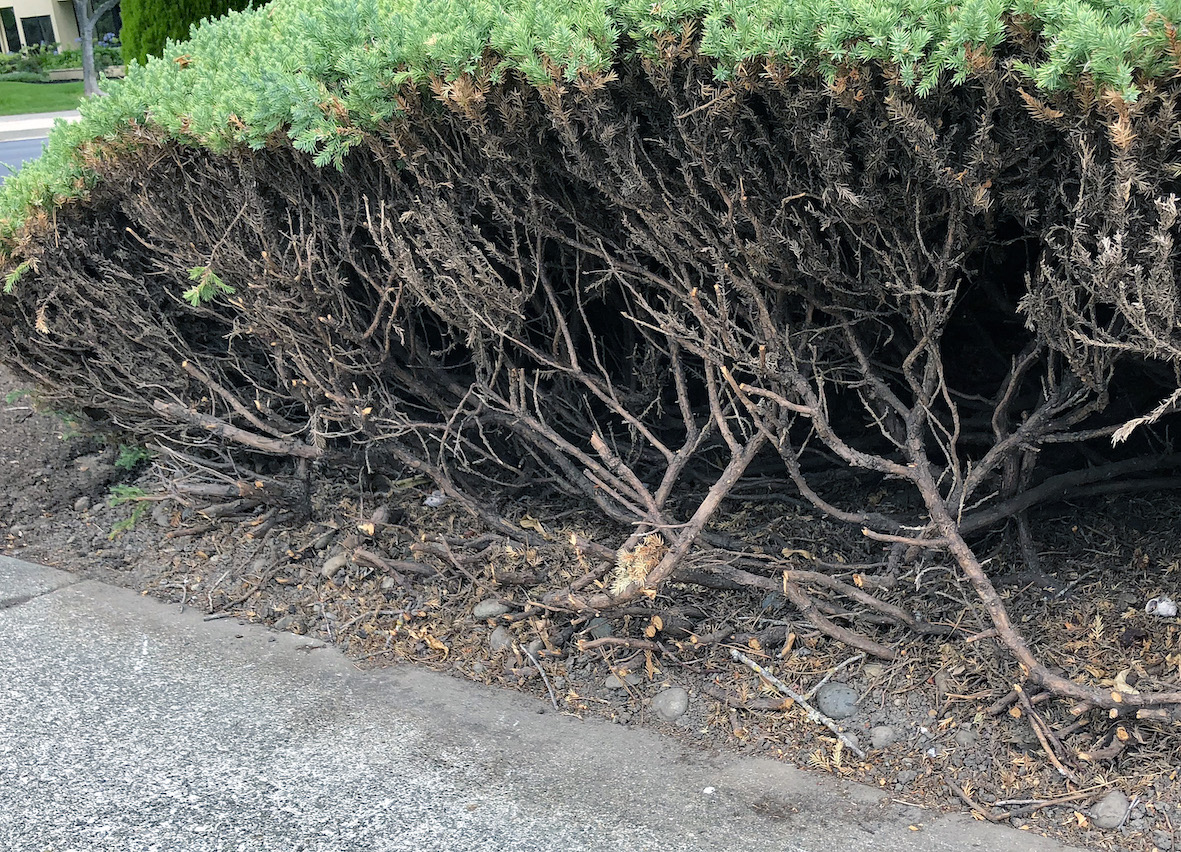
I need to trim a mature row of junipers along the side of the house. My neighbor trimmed his last year, and it looks like a 'brillo pad.' What is the proper way and time to prune junipers to avoid it from looking ugly?Answer:
- Junipers, cedars, redwoods, cypress and other conifers are pruned November through mid-April.
- Unlike other evergreen hedges, junipers are very slow to produce lateral growth off the bare, older branches. This presents problems when the junipers have been left to grow unattended over the years.
- They do not recover quickly from a heavy shearing; hence, you get a very unattractive ‘brillo pad’ look. Unfortunately, it will take several growing seasons for this look to disappear.
- Junipers have only one major flush of new growth per year, and that is in the spring
- Now to avoid this, you’re going to have to prune the junipers back in steps over the next several years always leaving some of the vegetative growth. I’m faced with a similar dilemma at my mothers-in-law house. She has a hundred feet long and twenty-foot wide row of juniper that edges the property along the street.
- This was a very typical landscaping pattern when the area was originally planted in the seventies. Besides, this would be a moot point if I wish to replace the juniper and relandscape the area, but I don’t. It’s going to be slow and tedious, but the alternative look is unacceptable.
- Another pruning note, wear gloves and a long sleeve shirt. The sharp needles from the junipers will puncture the skin. When the skin comes into contact with moisture, there will be a stinging/burning sensation that lasts for a few hours. Also, the puncture points will be red and sore for several days. A lesson I learned the hard way.
- There is a second reason for pruning now, as the open pruning wounds are a perfect entry point for insects. It takes a good week for the wounds to callus over or seal themselves. The activity of the harmful insects increases with the spring weather.
Question:
Is it safe to use the orange home depot buckets stamped with the number “2” recycling symbol for growing vegetables and small fruit trees? I’ve been reading about plastic containers, and they may not actually be food safe.Answer:
- High-density polyethylene (HDPE) is commonly recycled and has the number "2" as its recycling symbol.
- The plastic industry has recognized HDPE as the plastic container of choice to ensure the purity of its contents.
- Plastic milk containers and the non-clear variety of water jugs are made of High-Density Polyethylene; hence, I would have any concerns growing vegetables in them.
- That being said, I’d only grow those crops suitable for the size of the container. The orange buckets are too small for fruit trees and tomatoes but okay for peppers, squash, and cucumbers. Before planting be sure to punch several holes in the bottom for drainage.